Feedback and approvals
One Voice, One Place: Consolidating Client Feedback Before You Revise
Move client feedback out of email, chat and calls into one place, agree who speaks for the client and turn scattered comments into a clear change list.
By Ayebridge TeamPublished 7 min read
On this page
Feedback that lives in five places
You send a draft on Monday. By Wednesday the client's reaction is spread across an email reply, two messages in a chat app, a note scribbled during a call, and a forwarded comment from someone in their finance team you have never spoken to. None of it is wrong, exactly. But before you can change a single pixel or sentence, you have to find all of it, work out which parts still apply, and guess which comments carry the most weight.
That gathering work is invisible in most project plans, and it is where details slip. A comment buried in a chat thread gets missed, the client notices in the next round, and suddenly a small project feels like it is going in circles.
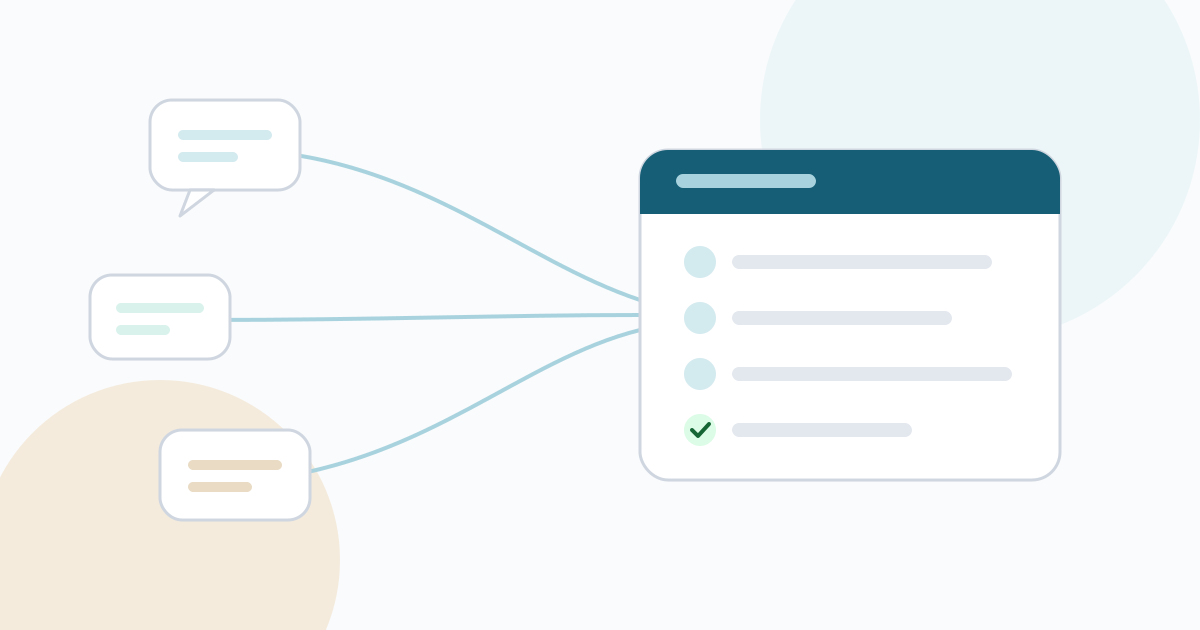
The fix is not to ask clients to give less feedback. It is to agree, early, on two things: where feedback goes and who speaks for the client. Everything in this guide builds on those two decisions.
Decide where feedback lives
Pick one home for feedback on each deliverable and say so at kickoff. It can be a project portal, a shared document or even a single email thread, as long as it is one place and everyone knows which one. The tool matters less than the agreement.
A good home for feedback has a few properties:
- It sits next to the work. Comments made beside the draft they refer to are easier to act on than comments that describe the draft from memory.
- It shows which version is being discussed. "The headline is too long" means little if there are three versions of the headline in circulation.
- It keeps history. You should be able to see what was said in round one when you are working on round three.
- The client can reach it without effort. If giving feedback in the agreed place is harder than sending a quick message, people will send the quick message.
In Ayebridge, each client gets a private portal where you post deliverables and ask for a decision with an approval request. The client either approves or requests changes, and a change request must include a comment, so the feedback for that version is attached to that version.
Name one person who speaks for the client
On most projects, several people on the client side have opinions. That is healthy. What causes trouble is when each of them sends their opinions to you directly and you become the person who has to reconcile them.
Ask the client to name one contact who consolidates their side's feedback. This mirrors a familiar idea from project management: responsibility charts such as RACI recommend a single accountable person per task, so that decisions have a clear owner. Your named contact doesn't need to write every comment. Their job is to collect input from colleagues, remove duplicates, settle disagreements and send you one list.
You can raise this in a kickoff call with something like:
"To keep each round quick, could you pick one person to pull everyone's comments together and send them to us as one set? They're also the person we'll ask to settle any conflicting requests."
Most clients welcome this. It saves them from embarrassing moments where two of their own people ask for opposite things.
The capture rule for everything else
Even with a clear home, feedback will still arrive elsewhere. A client mentions something at the end of a call. A stakeholder replies to a notification email instead of opening the portal. You can't prevent this, so plan for it with a simple rule:
If it isn't written down in the agreed place, it isn't part of the round yet.
Applying the rule politely looks like this:
- When feedback arrives by another route, thank the person and copy it into the agreed place yourself, with the date and who said it.
- If it came from a call, write a short summary and ask the named contact to confirm it.
- If it came from someone other than the named contact, flag it to the named contact rather than acting on it directly.
A reply you can reuse:
"Thanks, that's helpful. I've added it to the feedback list for round two so it sits with everything else. [Name], could you confirm this one is part of the agreed changes?"
This keeps the relationship friendly while making sure nothing is acted on outside the shared record.
Turn comments into a change list
Raw feedback is not a to-do list. Before you revise, convert it into a numbered change list that you and the client both agree on. This is the step that does the most to prevent a second or third round on the same issue.
Work through the comments in this order:
- Group by area. Put all comments about the homepage hero together, all comments about the pricing table together, and so on.
- Merge duplicates. Three people saying "the blue feels cold" is one change, not three.
- Separate preferences from problems. "I don't love this font" and "this font is hard to read on mobile" may lead to the same change, but they deserve different conversations.
- Mark conflicts. Where two comments pull in opposite directions, list them side by side and leave the decision to the named contact.
- Note what you won't change and why. If a request conflicts with an earlier decision or with the brief, say so plainly rather than quietly ignoring it.
- Flag anything outside scope. New pages, new features or a new direction belong in a separate conversation about scope, not in a revision round.
A change list can be as simple as this:
| # | Area | Change | Source | Status |
|---|---|---|---|---|
| 1 | Hero | Shorten headline to one line on mobile | Named contact | Agreed |
| 2 | Pricing | Show annual price first | Sales lead | Needs decision |
| 3 | Footer | Add office address | Named contact | Agreed |
| 4 | New page | Add a careers page | Marketing | Out of scope, discuss separately |
Send the list back and ask for a short confirmation before you start. Nielsen Norman Group's guidance on design critiques recommends agreeing on the scope and goals of a review up front, and following up with notes and action items afterwards. A confirmed change list is exactly that kind of follow-up.
Help the client write comments you can act on
Clients are rarely trained to give feedback, and vague comments are not a sign of a difficult client. You can make the job easier by sharing a short guide when you send the first draft. Keep it to a few lines:
- Point to the exact place. "Second paragraph on the About page" is easier to act on than "the copy".
- Describe the problem, not only the solution. "Visitors might not realize this is clickable" gives you room to find the best fix.
- Say how important it is. A simple "must change" or "nice to have" helps you prioritize within the round.
- Collect first, then send. One consolidated set of comments per round, from the named contact.
You can also ask a specific question with each review. "Does the page explain the three service tiers clearly?" gets sharper answers than "What do you think?"
A feedback round from start to finish
Here is how the pieces fit together in a single round:
- Share the draft in the agreed place, with a one-line note about what you would like the client to check and when you need their response.
- Collect comments in that place for the agreed window. Copy in anything that arrives elsewhere, using the capture rule.
- Close the round when the named contact confirms everything is in, or when the window ends.
- Build the change list, merging, separating and flagging as described above.
- Get confirmation of the change list from the named contact.
- Revise, then share the new version with a short summary of what changed against the list.
- Ask for a clear decision on the new version: approve, or request another set of changes.
Posting a short progress note at steps 3 and 6 keeps the client oriented. In Ayebridge that note goes on the project's updates timeline, so the client sees what happened in order, newest first, next to the work itself.
When clients push back on the process
Some clients are used to working differently. A few common reactions and calm responses:
"It's quicker if I just message you." It often is, for them. Agree that quick messages are fine, and explain that you will copy them into the shared list so nothing gets lost. Over time, many clients start using the shared place directly because it is where the answers are.
"Everyone on my team should be able to send feedback." They can. Invite them to comment in the shared place. The named contact simply makes the final call on what goes on the change list.
"Why do you need me to confirm the list?" Because it protects their time. If the list is wrong, catching it before revision costs a minute. Catching it after costs a round.
A short summary to keep
- One home for feedback per deliverable, agreed at kickoff.
- One named contact who consolidates and decides.
- Feedback from other channels gets copied into the shared place before anyone acts on it.
- Comments become a numbered, confirmed change list before revision starts.
- Each round ends with a clear decision on a specific version.
None of this requires a large process. It requires saying the rules out loud at the start, and following them consistently enough that the client sees how much smoother the rounds become. If revision rounds are a recurring source of friction, the next step is to put a clear limit on them in your proposal, which we cover in setting revision limits.
Frequently asked questions
What if the client insists on giving feedback by phone?
That is fine. Take notes during the call, then post a written summary in the agreed place the same day and ask the client to confirm it. The call stays convenient for them, and you still end up with one written record.
Who should be the single point of contact for feedback?
Usually the person who will sign off the work, or someone they trust to speak for them. They don't have to write every comment themselves, but they decide what goes on the final list and settle conflicts between colleagues.
How do I handle two stakeholders who want opposite changes?
Don't pick a side yourself. List both comments next to each other, explain the trade-off in a sentence or two, and ask your named contact to choose. Record the choice with the rest of the round.
Should I start revising before all the feedback is in?
It is usually better to wait until the round is closed. Work started on partial feedback often has to be redone when a later comment contradicts it, and that time rarely shows up in anyone's estimate.